Paper Highlights
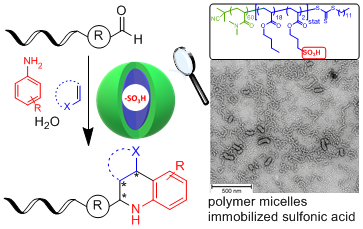
Micellar Brønsted Acid Mediated Synthesis of DNA-Tagged Heterocycles
M. Klika Škopić, K. Götte, C. Gramse, M. Dieter, S. Pospich, S. Raunser, R. Weberskirch, A. Brunschweiger
https://doi.org/10.1021/jacs.9b05696
DNA-encoded libraries are increasingly used of drug identification. However, the reactivity of the DNA imposes limitations on the choice of chemical methods for encoded library synthesis. Amphiphilic block copolymers covalently functionalized with sulfonic acid moieties in the lipophilic portion assemble in water and locate the Brønsted catalyst in micelles. These acid nanoreactors enabled the reaction of DNA-conjugated aldehydes to diverse substituted tetrahydroquinolines and aminoimidazopyridines by Povarov and Groebke–Blackburn–Bienaymé reactions, respectively.
Rolling circle amplification shows a sinusoidal template length-dependent amplification bias
Bastian Joffroy, Yavuz O. Uca, Domen Prešern, Jonathan P. K. Doye, Thorsten L. Schmidt
Nucleic Acids Res. 2018, DOI:10.1093/nar/gkx1238
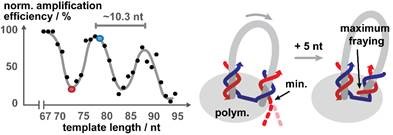
Small DNA circles can serve as templates for rolling circle amplification (RCA), which is a common and extremely robust amplification mechanism for nucleic acids. We discovered a strong template length-dependent amplification efficiency bias of RCA with the same periodicity as B-DNA.
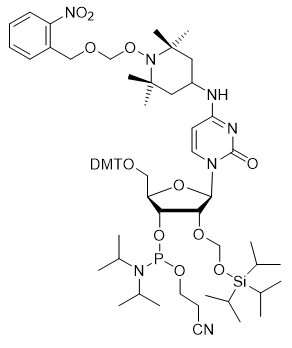
A cytidine phosphoramidite with protected nitroxide spin label: Synthesis of a full-Length TAR RNA and investigation by in-line probing and EPR spectroscopy
Timo Weinrich, Eva A. Jaumann, Ute Scheffer, Thomas F. Prisner, Michael W. Göbel
Chem. Eur. J. 2018, DOI:10.1002/chem.201800167
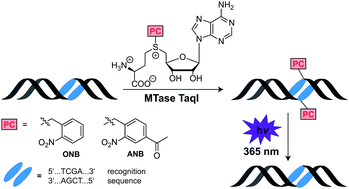
A photolabile 2-nitrobenzyloxy methyl group can protect nitroxide spin labels against all critical conditions of chemical RNA synthesis and enzymatic strand ligation.
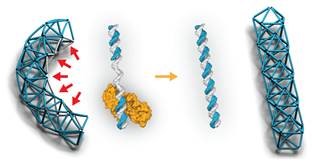
Structural transformation of wireframe DNA origami via DNA polymerase assisted gap-filling
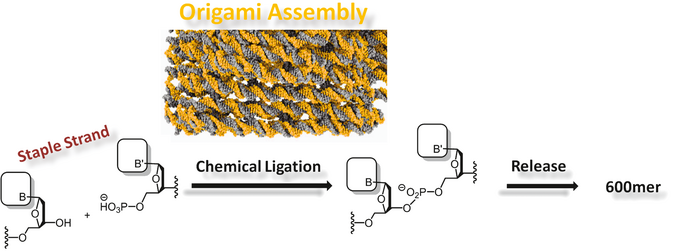
Enzyme-free ligation of 5'-phosphorylated oligodeoxynucleotides in a DNA nanostructure
Markus Kramer, Clemens Richert
Chem. Biodiversity 2017, DOI:10.1002/cbdv.201700315 (open access)
Chemical ligation of synthetic oligonucleotides in small origami nanostructures is higher yielding than in linear duplexes.